Container Iso Marini nuovi usati
8' - 10' - 20' -
40' X 8' X 8'6" ISO 1AA TYPE STEEL DRY CARGO CONTAINER

Produzione Noleggio
Vendita |

Container ISO 20'
40' Box ISO Nuovi Usati |
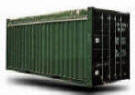
Container 20' 40' Open Top
originali e
Trasformati |
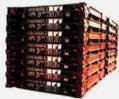
Container 20'
40' Flat Rack PlaContainerInverter orm
Pianali |
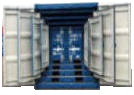
Container speciali 6' 8' 10'
15 carpenteria' |

Container
per Vernici - Olii con vasca + griglia |
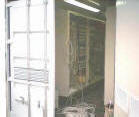
Container per Quadri
Elettrici Trasformatori |

Reefer Container Frigo,
temperatura Controllata |
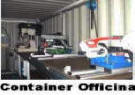
Container Officina con banchi lavoro,
paranchi |
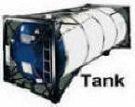
Tank Container
IMO |

Flexitank,
Liquidi non pericolosi |

Container Shelter, Vani Tecnici, Insonorizzati |

Container
Protezione Civile Croce Rossa / CSC |

Monoblocchi
Shelter per inverter per impianti Fotovoltaici |
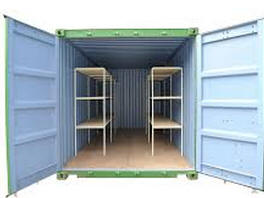
Container
con Scaffali ripiani, preumatici |

Container
DVN 2.71 EN1207, per piattaforme Off Shore |
Container show vetrine itineranti' |
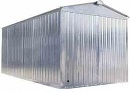
Box
lamiera zincata a pannelli capriate ecc. |

Container Antincendio CO2 Vigili del Fuoco |
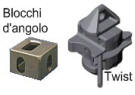
Blocchi
d'angolo Corner casting, accessori, Twist interbloccanti, |
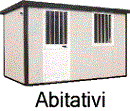
Monoblocchi coibentati Prefabbricati Cantiere |
Azienda Certificata UNI EN ISO 9001 :
2008 (sito nato nel 1999 ! un punto di
riferimento per chi cerca container) ;
Dove Siamo (area Raccordata),
Referenze Lavori Consegnati, PI 07411800159

N orma
ISO CSC Container
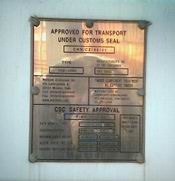
safety commition 1972 VEDI SOTTO
Targhetta CSC applicata normalmente sulla
porta sinistra del Container ISO
,
Misure dei
container Classificazione ISO 668-1995
Norrme
ISO/CSC,
norma
movimentazione ISO 3874 - 1997
Commissione
TC 104 sui Container,
ISO
1161 blocchi d'angolo,
Norme Atex
;
Etichette pericolo,
Trasporto su
strada materiali pericolosi
Le caratteristiche dei container marittimi ISO devono
rispettare i principi contenuti nella
Norma con
ISO 668-1995
NORMA ISO 3874-1997 SULLA MOVIMENTAZIONE DEI CONTAINER.
Waldem Container Box può offrire in vendita o noleggio I container di
seguito descritti .
Attenzione per i containers Open top Originali e trasformati vanno
usate particolari attenzioni per le movimentazione (richiedere a Waldem
Container Box ulteriori dettagli)
Container Handling and Securing Considerations (Ref ISO
3874-1997 (E)):
| |
|
| • |
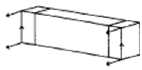
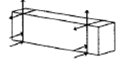
For the purpose of container handling and securing, a “loaded
container” is a container other than in the tare (empty) condition. |
| • |
Unless otherwise confirmed, containers should be treated as
loaded. |
| • |
The term loaded means the maximum gross weight rating of the
container. |
| • |
Wind and other environmental conditions must be considered when
handling or securing containers. |
| • |
The cargo shall be distributed throughout the container to ensure
that the centre of gravity is kept as central and as low as possible: |
| |
| - |
to avoid excessive tilting; |
| - |
to avoid overstressing either the container or
the handling equipment; |
| - |
to avoid unacceptable vehicle axle loading; |
| - |
to avoid lack of vehicle stability; |
| - |
to avoid unacceptable load concentrations. |
|
| |
Eccentricity of the center of gravity for the loaded container
varies with the distribution of load within the container; designers
of containers and handling equipment should take this fact into
account. As an example, when 60% of the load by mass is distributed in
50% of the container length measured from one end, the eccentricity
corresponds to 5%. |
| • |
Care shall be taken to ensure that the equipment used
is suitable for the load and is safely attached to the container and
that the container is free to be handled. |
| • |
In the case of a single-point lift, special attention
should be paid to the risk of the container tilting owing to
eccentricity of the centre of gravity. |
| • |
Care shall be taken when lifting a container whose
centre of gravity is mobile or eccentric, e.g. a tank container, a
bulk container, a container with a liquid bulk bag, a container with
hanging cargo or a thermal container with a refrigerating unit
(integral or clip-on). |
| • |
Containers may be handled by methods other than those
specified in the following section but only after careful evaluation
of the equipment by means of which the container is to be handled and
of the methods of operation envisaged, with respect to international
container standards. |
| |
|
|
| Summary of Allowable and Not Allowable Lifting Methods: |
| • |
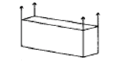
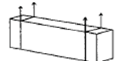
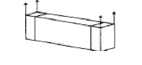
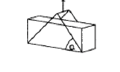
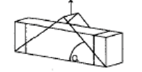
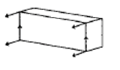
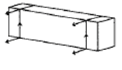
Lifting containers from the top corner fitting with
forces applied other than vertically, is not allowed according to ISO
3874: 1997 (E) EXCEPT: |
| |
• |
Empty containers (except empty plaContainerInverter orm
based containers and plaContainerInverter orm based with ends, which shall not be
lifted other than with forces applied vertically from the top
corners). |
| |
|
• |
When lifting empty containers, the sling angle should
not be less than 60 degrees from the horizontal plane. |
| |
• |
Ten foot containers using a sling angle
of not less than 60 degrees to the horizontal plane. |
| • |
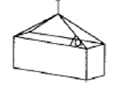
Containers may be lifted from the side
apertures of all four bottom corner fittings by means of a sling. The
attachment fittings should not exert forces more than 1.5 inches away
from the outer face of the Corner Fitting. |
| • |
The minimum lifting angle for loaded
containers lifted from the bottom corners is as follows: |
| |
|
| Container Size Designation |
Lifting Angle, a, min. |
| 1AAA; 1AA; 1A; 1AX |
30 Deg |
| 1BBB; 1BB; 1B; 1BX |
37 Deg |
| 1CC; 1C; 1CX |
45 Deg |
| 1D; 1DX |
60 Deg |
|
|